


A Franciscan Gospel Reflection for the Sixth Sunday of Ordinary Time 2026 is shared here for your prayer. What are your thoughts and feelings about Lent this year?
The Gospel background and reflection questions are prepared and distributed by Franciscan Sister of Christian Charity Sister Anne Marie Lom, OSF and Joe Thiel, as edited from Reflections authored by Fr. Paul Gallagher, OFM. The excerpts from the Sunday readings are prepared by Joe Thiel. To read or download the complete pdf with excerpts for your prayer, please click here: Franciscan Gospel Reflection February 22 2026
Excerpts from the Lectionary for Mass for Use in the Dioceses of the United States of America, second typical edition © 2001, 1998, 1997, 1986, 1970 Confraternity of Christian Doctrine, Inc., Washington, DC. Used with permission. All rights reserved. No portion of this text may be reproduced by any means without permission in writing from the copyright owner. Photos: Franciscan Sisters of Christian Charity; FredSeiller, CC0, via Wikimedia Commons
Matthew 4:1-11
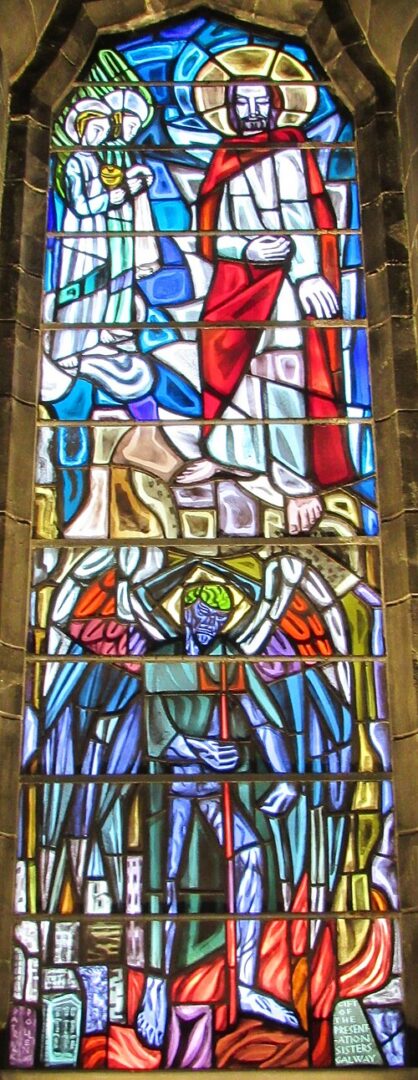
At that time Jesus was led by the Spirit into the desert to be tempted by the devil. He fasted for forty days and forty nights, and afterwards he was hungry. The tempter approached and said to him, “If you are the Son of God, command that these stones become loaves of bread.” He said in reply, “It is written: ‘One does not live by bread alone, but by every word that comes forth from the mouth of God.'”
Then the devil took him to the holy city, and made him stand on the parapet of the temple, and said to him, “If you are the Son of God, throw yourself down. For it is written: “’He will command his angels concerning you’ and ‘with their hands they will support you, lest you dash your foot against a stone’.” Jesus answered him, “Again it is written, ‘You shall not put the Lord, your God, to the test.'”
Then the devil took him up to a very high mountain, and showed him all the kingdoms of the world in their magnificence, and he said to him, “All these I shall give to you, if you will prostrate yourself and worship me.” At this, Jesus said to him, “Get away, Satan! It is written: ‘The Lord, your God, shall you worship and him alone shall you serve.'” Then the devil left him and, behold, angels came and ministered to him.
Background:
For the past several weeks the Gospel readings have dealt with Jesus teaching the disciples what it means to be his followers, and how his followers will be expected to conduct themselves. These recent passages have all been from the Sermon on the Mount, which Jesus relates in the Gospel of Matthew. The church has a prescribed pattern for which Gospels are read on each of the six Sundays of Lent, and so as we begin Lent, this Sunday’s Gospel text takes a dramatic shift. We go back in Matthew to a reading we did not take in order. The first Sunday of Lent always presents an account of Jesus being directly tempted by the devil. As we proceed further into Lent, the Gospel for the second Sunday of Lent will be an account of the Transfiguration. This year that text will also come from Matthew. The next three Gospel texts will be taken from John’s Gospel: the Samaritan woman at the well from chapter 4; the curing of the man born blind from chapter 9; and the raising of Lazarus, taken from chapter 11. The last Sunday of Lent is Passion Sunday, and that Gospel will again come from Matthew. After this Sunday, none of these Gospels center on threats of punishment or turning from temptation and evil, but rather their focus is on the goodness of God overflowing and becoming manifest.
As Matthew presents the sequence of events leading up to Jesus’ temptation, this follows directly after Jesus’ baptism (Matthew 3:13-17, a reading that we had in mid-January). Matthew describes Jesus coming out of the water and seeing “the Spirit of God descending like a dove and coming upon him. And a voice came from the heavens, saying, ‘This is my beloved Son, with whom I am well pleased’” (Matt 3:16-17). Immediately following this, Matthew’s Gospel describes Jesus being led by the spirit into the desert to be tempted, and this is the Gospel text for this Sunday.
Matthew’s community assumed an understanding of the presence of evil in the world in ways that most modern readers might dismiss as naive or even fanciful. They believed that there was an abundance of evil spirits whose main pastime was interacting with humans, occasionally providing a surprising blessing, but more often with ill intentions. In order to ward off the ill effects of these spirits, people relied on objects, tokens, and ritual actions and prayers that were believed to have protective powers. This spirit world also enjoyed its own form of communication and being connected, so that what happened in one part was known by the others. The fact that God had said of Jesus that this was “my beloved Son with whom I am well pleased” would naturally draw a response from others in the spirit world. Other spirits would want to know if Jesus was indeed worthy of such praise, and they would tempt him in such ways that might cause him to lose his favored status.
With their understanding, it is no surprise for the people for whom Matthew is writing, that, following the baptism, Jesus is tempted by the devil. What is surprising is that Jesus does not rely on any of the things that they would have used to protect themselves from the powers of the spirit world—even after he has fasted for forty days and is hungry and vulnerable on many levels.
Matthew is also making use of the community’s familiarity with the events of the Exodus from Egypt. For one thing, all three responses of Jesus to the temptations are quotations from the description of Israel’s wandering in the desert, as recorded in the book of Deuteronomy (8:3, 6:16 and 6:13). Also, Jesus’ temptation and the Exodus both take place in the desert, the place normally associated with the evil spirits. Matthew’s readers would also recognize that the Israelites spent forty years in the desert, and Jesus has been fasting in the desert for forty days and forty nights. Matthew is building a connection between the experience of their ancestors in faith and the experience of Jesus.
As Matthew describes it, the last temptation places Jesus on a very high mountain. Mountains were places of revelation, and the story of Moses’ encounter with God on the mountain was familiar to Matthew’s readers. Next week, Matthew’s Gospel will again place Jesus on a high mountain, this time with three of the disciples, for the transfiguration. Matthew’s community knew well the tradition that the mountain was the place where God revealed the relationship God desired to have with them as the chosen people.
Reflection Questions:
- What are your thoughts and feelings about Lent this year?
- Have you ever thought about what God desires for you during the Lenten season, so that you will better celebrate the resurrection, Easter, and the eternal life God desires to share with you?
- What is your experience of evil in your life and/or in the world around you?
- What do you rely on to protect you from the power of evil?
- How do you experience occasions of temptation at this stage of your life?
- Jesus is tempted to use his status as beloved Son of God for his own purposes: to ease his hunger, to experience God’s protection, and to be treated as one who is above others. In his rejection of the temptations, Jesus refuses to use his status as highly favored Son of God and instead he demonstrates his choice to be one of us, even in being tempted. What does that say to you?
- What do you think Jesus learned about himself from his experiences of being in the desert, the temptations, and how he responded?
- As you reflect on this text, what sense of yourself and your relationship with God come to the fore within you? Can you take some time to talk with God about your own awareness of being tempted, or how you would like to use this season of Lent?
The post First Sunday of Lent 2026 Franciscan Gospel Reflection appeared first on Franciscan Sisters.