


Franciscan Friar Fr. Paul Gallagher reflects on the Gospel readings for the feast of the Baptism of the Lord. Jesus left his home and familiar surroundings to be baptized. Are there things that you have left behind in order to respond to God’s invitation?
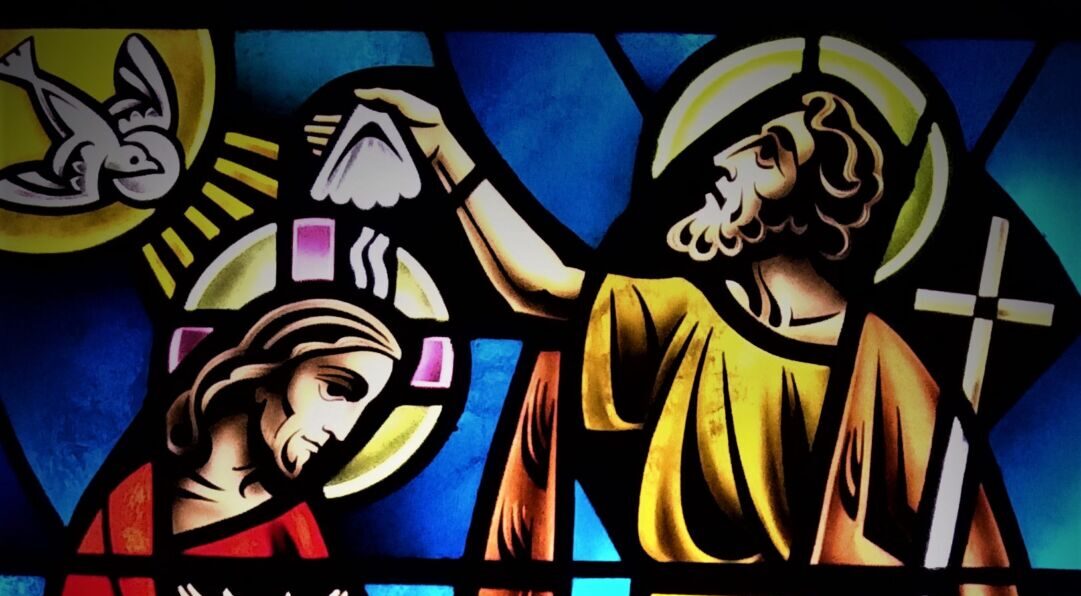
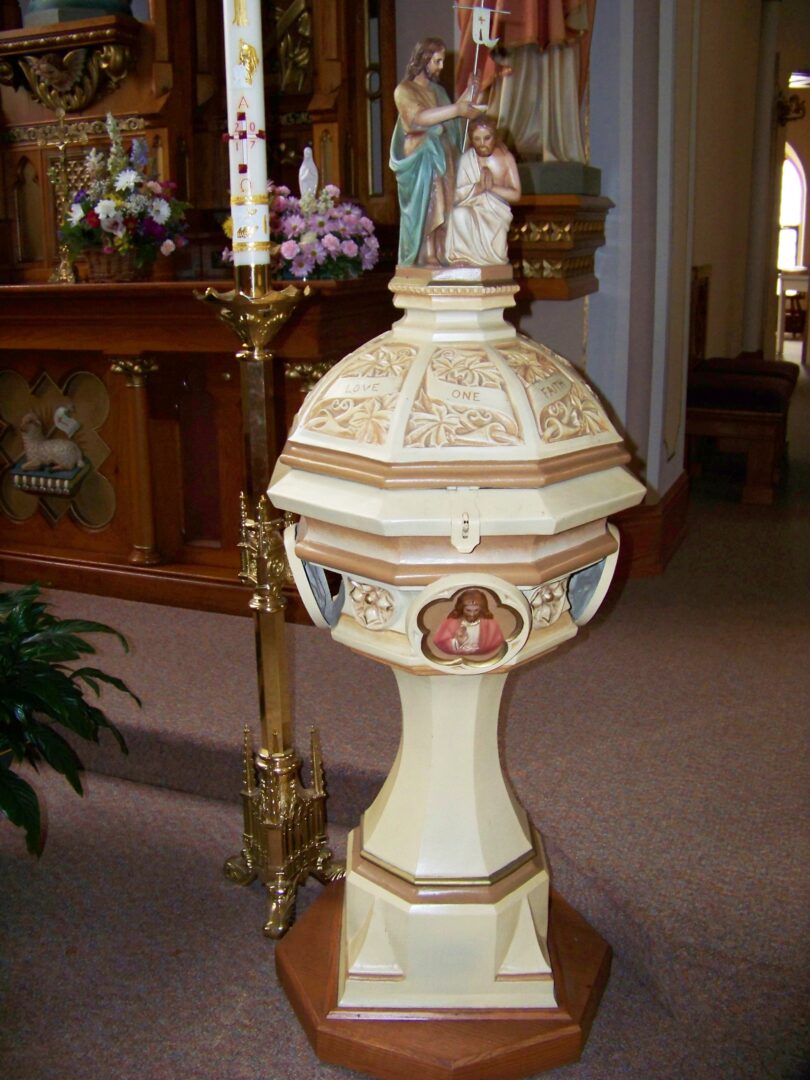
The content is edited by Franciscan Sister of Christian Charity Sister Anne Marie Lom and Joe Thiel. The excerpts from the Sunday readings are prepared by Joe Thiel. To read or download the complete pdf with excerpts for your prayer, please click here: Franciscan Gospel Reflection January 11 2026. Excerpts are from the Lectionary for Mass for Use in the Dioceses of the United States of America, second typical edition © 2001, 1998, 1997, 1986, 1970 Confraternity of Christian Doctrine, Inc., Washington, DC. Used with permission. All rights reserved. No portion of this text may be reproduced by any means without permission in writing from the copyright owner. Photo: The Diocese of Madison shares these images to enhance the celebration of the feast. St. Henry, Watertown, Wisconsin; baptismal font St. Peter Chapel, Ashton, Wisconsin
Matthew 3:13-17
Then Jesus came from Galilee to John at the Jordan to be baptized by him.
John tried to prevent him, saying, “I need to be baptized by you, and yet you are coming to me?” Jesus said to him in reply, “Allow it now, for thus it is fitting for us to fulfill all righteousness.” Then he allowed him.
After Jesus was baptized, he came up from the water and behold, the heavens were opened for him, and he saw the Spirit of God descending like a dove and coming upon him. And a voice came from the heavens, saying, “This is my beloved Son, with whom I am well pleased.”
Background:
For the early Christian community, the baptism of Jesus is an important event. Perhaps because it was also controversial, all four Gospel writers chose to include their own description of the event in their Gospels (Mk 1:9-11, Lk 3:21-22, Jn 1:31-34). One problem was that if Jesus was the messiah and more significant than John, why did he submit to being baptized by him? Their culture was based on maintaining one’s place and dignity within the community. An essential part of this was maintaining an appropriate distance from those who were subordinate to you. By submitting to John’s baptism, Jesus seemed to acknowledge John’s superiority.
Scripture scholars believe that Matthew had knowledge of Mark’s Gospel. By looking at how Matthew has changed Mark’s description of the Baptism, one can see how Matthew dealt with these issues for his community. Mark’s account follows:
The beginning of the Gospel of Jesus Christ (the Son of God). As it is written in Isaiah the prophet: “Behold, I am sending my messenger ahead of you; he will prepare your way. A voice of one crying out in the desert: ‘Prepare the way of the Lord, make straight his paths.'” John the Baptist appeared in the desert proclaiming a baptism of repentance for the forgiveness of sins. People of the whole Judean countryside and all the inhabitants of Jerusalem were going out to him and were being baptized by him in the Jordan River as they acknowledged their sins. John was clothed in camel’s hair, with a leather belt around his waist. He fed on locusts and wild honey. And this is what he proclaimed: “One mightier than I is coming after me. I am not worthy to stoop and loosen the thongs of his sandals. I have baptized you with water; he will baptize you with the Holy Spirit.” It happened in those days that Jesus came from Nazareth of Galilee and was baptized in the Jordan by John. On coming up out of the water he saw the heavens being torn open and the Spirit, like a dove, descending upon him. And a voice came from the heavens, “You are my beloved Son; with you I am well pleased.” (Mark 1:1-11)
Note first that Mark begins his Gospel with the Baptism. Unlike Mark, Matthew does not describe the Baptism until the third chapter of his Gospel. Matthew begins by placing the life and ministry of Jesus in a historical context:
- He traces Jesus’ genealogy back to Abraham (Matt 1:1-17);
- He describes Jesus’ birth in a way that highlights how the events fulfill what had been foretold (Matt 1:18-25);
- He notes that foreign unbelievers were able to determine the significance of Jesus’ birth because of a great sign in the sky (Matt 2:1-12);
- He presents the responses of all of Jerusalem—religious leaders, civil leaders and all the people—to the news of Jesus’ birth (Matt 2:7-23).
Only after Matthew has set the stage is he ready to introduce John the Baptist (Matt 3:1-12), and Jesus’ baptism by John in the Jordan, which is the text for this Sunday’s Gospel. Matthew first tells his audience that Jesus left the familiar surroundings of Galilee and his family relationships to travel to the Jordan to be baptized by John. Travel was never easy; whenever one made a journey, they did so with intention. Matthew states that Jesus has left Galilee, his home, and that furthermore he is traveling to the Jordan, in order to be baptized by John.
Matthew reports that when Jesus and John meet, John recognizes that Jesus is the more significant person, and states that it is not appropriate for him to baptize Jesus. John longs for the coming of the messiah who would bring a baptism of power, fire, and judgment. Jesus asks John to suspend the cultural norms of the day in order to conform to what God desires of him. “Allow it now, for thus it is fitting for us to fulfill all righteousness” (Verse 15). Jesus understands himself to be the servant of God. As God’s servant he believes that above all else he must be obedient to God. His baptism is part of God’s plan, and therefore he accepts God’s desire for him. This is affirmed by God, who is fully present and affirms what has taken place, in the voice from heaven and in the presence of the dove, a sign of the Holy Spirit. As described by Mathew, this is not a private moment between Jesus, the Father, and the Holy Spirit, but one that John and all those present also experience.
The second problem of Jesus being baptized is that John’s baptism was a baptism of repentance from sin. Jesus comes to John for baptism, not necessarily as sinful, but as one whose life is about to take a radical shift, from being the son of a carpenter to being a prophetic voice to the people. The very next episode in Matthew’s Gospel presents Jesus being led into the desert to be tempted. Even though he is weak from fasting, he remains faithful to being one of us, human, capable of weakness, without making use of divine power or privilege.
Reflection Questions:
- Jesus left his home and familiar surroundings to be baptized. Are there things that you have left behind in order to respond to God’s invitation?
- Have there been or are there places where you may be resisting leaving the familiar or the comfortable in your journey?
- The baptism of Jesus presents us with an image of Jesus who considered it more important to be obedient to the will of God than to follow the norms of what was proper behavior of the day. Jesus and John, in this Gospel, deal with the conflict between what is expected from them by religious and cultural traditions and what they believed God was asking of them. Neither of them had the confirmation of the voice of God until after they had chosen to act. Have there been times in your life when God seemed to be waiting for you to decide or act, and it was only after you had acted that God confirmed your decision? Are there times when you did not act because you were waiting for God to give you direction?
- Jesus was willing to risk being counted among the sinners by others. Have you ever been in a position where in order to respond to God your reputation might suffer?
- Do you think Jesus purposely chose to join those going out to the Jordan to be baptized? How is that consistent with Jesus’ behavior in other places in the Gospels? What is Jesus saying to you by his choosing to be present with us?
- Who has told you that you are beloved and that they are proud of you? How did their comments affect you?
- Do you state that sentiment to others around you?
- Present at the baptism are John the Baptist, Jesus the son of Mary and the Son of God, the Father, the Holy Spirit, and those others that might have gathered that day. What does this event say to you from each of their perspectives? How would you like to respond?
The post Baptism of the Lord 2026 Franciscan Gospel Reflection appeared first on Franciscan Sisters.